












Earth Day is an invitation to remember what is easy to forget in the pace of ordinary life: that we are not separate from the natural world. We are made of it. Every system that sustains us, from the water in the ground to the plants that clean the air, is older and wiser than anything we have built on top of it.
There is a Japanese concept called satoyama, the space between mountain wilderness and cultivated farmland, where humans and nature negotiate a gentle coexistence. It is neither fully wild nor entirely tamed. It is, in many ways, a metaphor for the relationship we are learning to rebuild with the living world: not conquest, not passive observation, but active, humble, reciprocal care.

The Language of Plants
Long before the modern beauty industry existed, communities across the world were formulating potent remedies from what grew around them. Ayurvedic practitioners pressed oils from bhringraj and amla. Women across West Africa refined shea from the karite tree. In the Pacific, kawakawa and kumarahou were sacred medicines, applied with ceremony and intention.
These traditions were not accidents. They were the result of generations of close, patient observation: learning to read a plant's signals, to understand its relationship to soil, season, and the particular needs of the human body. That knowledge took centuries to accumulate, and it has not expired.
What we call "active ingredients" in contemporary formulation, older traditions simply called medicine. The line between scalp care and plant wisdom was never drawn, because the two were never separate.

Tending Your Roots
The scalp is, in many traditions, considered the root of the body's vitality: the place where hair, that visible record of health and time, grows outward into the world. To care for it is to tend to your roots in the most literal sense.
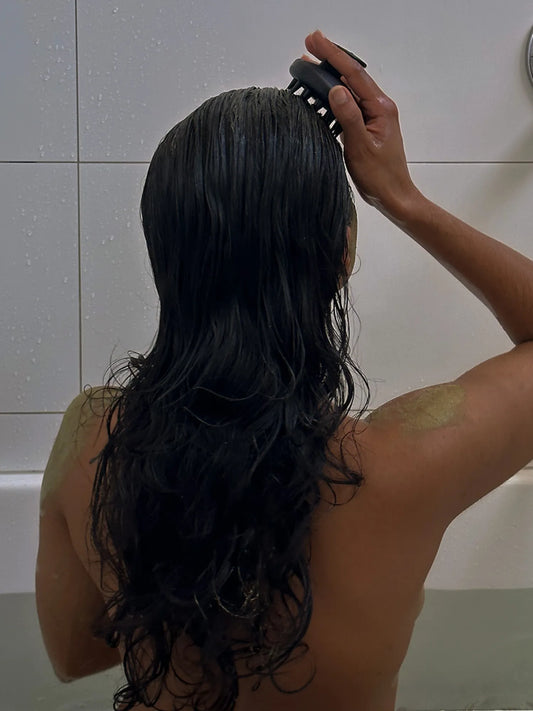
A good hair growth oil, massaged in slowly with circular motions and genuine presence, is one of the oldest forms of self-care on earth. Warming a few drops between your palms, working through the scalp with intention: these are acts of care directed both inward and outward. When you nourish your hair with something drawn from the earth and handled with respect, you close a loop that has been closing for thousands of years.

Ceremony as Ecological Practice
There is an argument, quiet but growing louder, that the loss of ritual in everyday life is not merely a psychological problem. It is an ecological one. When we move through our days too quickly to notice what sustains us, we lose the capacity for gratitude. And without gratitude, stewardship becomes obligation rather than love.
Shinrin-yoku, or forest bathing, is the Japanese practice of immersing yourself in woodland air, and research has consistently found that time among trees lowers cortisol, slows the heart, and restores something the nervous system loses in urban environments. Not everyone can reach a forest when they need one, but scent is a powerful carrier of place. A stick of natural botanical incense, something that smells genuinely of earth and wood rather than a laboratory, can shift the quality of a moment entirely. Light one before your scalp ritual. Let the room change around you.
